
Ask ten Maine Coon owners what color their cat is, and half of them will get it wrong. That "orange" cat is technically red. That "gray" one is blue. And the cat that looks solid black might be a black smoke hiding a silvery undercoat.
Maine Coons is one of the widest color ranges of any cat breed. This guide covers all of it: every major color category, the patterns layered on top, eye colors, the genetics, and a simple checklist for identifying your own cat's coat.
How Many Maine Coon Colors Are There?
The Cat Fanciers' Association (CFA) recognizes more than 75 color and pattern combinations for Maine Coons. Nobody memorizes all of them — breeders just group them into a handful of categories: solid, tabby, tabby with white, smoke and shaded, tortoiseshell, calico, bi-color, and parti-color.
A Maine Coon's look is just color (black, red, blue, cream, white) plus pattern (solid, tabby, smoke, tortie, with or without white). Mix and match those two ingredients and you get every official combination on pedigree papers.
The only colors you won't see in a purebred Maine Coon are the ones that signal crossbreeding — chocolate, lavender, and the pointed Siamese-style pattern aren't accepted by the CFA.
Solid Maine Coon Colors
Solid Maine Coons wear one even color from nose to tail, no tabby markings. True solids are less common than you'd think — tabby is the breed's genetic default, and hiding those stripes takes a specific gene combination.
Black Maine Coon
A solid black Maine Coon is a striking cat: dense, coal-black fur from root to tip.
Part the fur and see a pale silvery base? That's a black smoke, not a true solid.
Black Maine Coons typically have gold or copper eyes that pop against the dark coat, and that "gentle black panther" look keeps them in high demand.

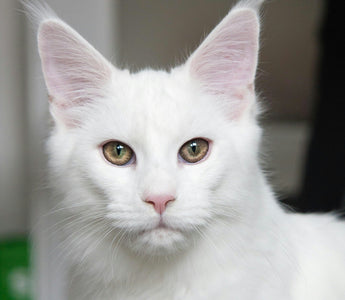
White Maine Coon
Solid white Maine Coons aren't actually "colored" white. They carry a masking gene that hides whatever color sits underneath, leaving a pure white coat.
Their eyes can be blue, gold, copper, or green — or odd, meaning one blue and one gold or green. Odd-eyed whites are especially prized.
One honest note: blue-eyed white cats have a higher chance of being born deaf, and odd-eyed whites may be deaf on the blue-eyed side.

Blue Maine Coon
"Blue" is what most people simply call gray. Genetically, a blue coat is actually diluted black, created by a dilution gene that softens the pigment into a smooth blue-gray shade.
A high-quality solid blue coat is even in color, no hidden markings, and often paired with striking gold or copper eyes. Its elegant appearance photographs exceptionally well, making blue Maine Coons a favorite across social media.
Red Maine Coon
There's no such thing as an "orange" cat in official terms, it is actually red. The color comes from a gene on the X chromosome, which is why roughly 80 percent of red cats are male. The red gene doesn't fully hide tabby markings, so almost every "solid" red shows at least faint stripes. Truly solid reds are extremely rare.

Cream Maine Coon
Cream is also a diluted version. The same dilution gene softens red into a pale, warm buff. Cream Maine Coons look almost pastel and usually show faint stripes. It's one of the rarer solids.

Tabby Maine Coon Colors
Time to clear up the biggest confusion in cat colors: tabby is not a color. It's a pattern.
A tabby Maine Coon can be brown, silver, red, blue, or cream underneath its stripes. The pattern is the markings; the color is the pigment they're made of.
Every tabby wears the signature "M" on its forehead. It's what the original Maine farm cats wore, and it's still the breed's most common look.
Brown Classic Tabby
The brown classic tabby is the iconic Maine Coon. "Classic" refers to the pattern: bold, swirling black markings that form a bullseye shape on each side, over a warm brown ground. Big circular swirl instead of straight stripes? You've got a classic tabby.

Brown Mackerel Tabby
Same brown coloring, different pattern. Mackerel tabbies have narrow, parallel stripes running down the sides like fish bones. The side markings separate mackerel from classic at a glance.
Silver Tabby
Silver tabbies carry an inhibitor gene that switches off pigment at the base of each hair. The result: crisp dark markings floating on a shimmering, almost-white background. The high contrast makes them easy to spot — the background looks polished silver, not brown or gray.

Red Tabby
Red tabbies are the classic "big orange cat" — warm ginger stripes over a lighter cream-red ground. Because the red gene lets markings show through so easily, red tabbies far outnumber solid reds. Most are male, and they typically have gold or copper eyes.
Blue Tabby
A blue tabby wears soft gray-blue markings over a pale ivory ground. It comes in classic and mackerel patterns.
Smoke and Shaded Maine Coons
Smoke Maine Coons are the breed's great impostors. At rest, a black smoke looks solid black. Genetically, smokes carry the same inhibitor gene as silver tabbies: it bleaches the base of each hair while the tip keeps its full color. Common varieties include:
- Black smoke — black tips over a silver-white base; the most dramatic and best known
- Blue smoke — the diluted version, with blue-gray tips over a pale base
- Silver shaded — color limited to the very hair tips, so the cat looks silvery-white with a light dusting of color
The difference between smoke and shaded is how much of each hair carries color: about half for smokes, an eighth for shadeds. Wondering if your "solid" cat is secretly a smoke? Part the fur along the back — a white or silver base gives it away.

Tortoiseshell Maine Coons
Tortoiseshell — "tortie" for short — is a marbled mix of black and red woven together, appearing as cream and blue in the diluted version.
The genetics explain the most famous tortie fact: they're almost always female, since showing both black and red at once takes two X chromosomes. Male torties are extraordinarily rare — about 1 in 3,000 — and usually sterile. Common variations include:
- Black tortie — black brindled with red patches
- Blue-cream (dilute tortie) — soft blue-gray mixed with cream
- Tortie tabby (torbie) — tortie colors with tabby striping layered on top
No two torties look alike — a big part of their appeal.

Calico Maine Coons
Calico and tortoiseshell get mixed up constantly. Here's the distinction:
- Tortoiseshell: black and red woven and brindled together, with little or no white
- Calico: distinct, separate patches of black, red, and white, with white usually covering a third or more of the body
A tortie looks like the colors were stirred together; a calico looks like they were placed side by side on a white canvas. Genetically, a calico is just a tortoiseshell with a strong dose of the white spotting gene. Like torties, they're almost always female. Dilute calicos — blue, cream, and white — are an especially soft, pastel look.

Bi-Color and Parti-Color Maine Coons
Bi-color Maine Coons pair one color with white patches, usually on the chest, paws, belly, and face. Common combinations include:
- Black and white — the tuxedo look; crisp, formal, always popular
- Blue and white — soft gray-blue with white; a gentler take on the tuxedo
- Red and white — vivid ginger and white.
The amount of white ranges from a small chest patch to the "van" pattern, where the cat is mostly white with color only on the head and tail.
Parti-color is the broader term for multiple colors plus white, calicos and torties included.
Rare Maine Coon Colors
The rarest Maine Coon colors are solid white, odd-eyed white, silver, smoke, and shaded — plus truly solid red and male tortoiseshells, which are genetic flukes. Each needs a specific, less widely bred gene, and odd-eyed white takes two at once.
Maine Coon Eye Colors
Maine Coon eyes range from gold to copper to green, with blue and odd eyes reserved for white or mostly white cats. Eye color isn't strictly tied to coat, with a couple exceptions.
- Gold: the most common, from pale yellow to rich amber
- Copper: a deep orange-brown, striking on black and blue cats
- Green: gooseberry to deep emerald; common in silver tabbies
- Blue: only in white or high-white cats, where the masking or spotting gene affects eye pigment too
- Odd eyes: one blue and one gold or green, seen in white and bi-color cats
All Maine Coon kittens are born with blue eyes. Adult color develops between 4 weeks and 6 months, so don't judge too early.
Do Maine Coon Colors Change as They Grow?
Yes — within limits. A Maine Coon's genetic color is locked in at birth, but how it looks can shift over the first few years. Here's what changes:
- Kittens: fuzzy baby coats blur the adult pattern. Tabby markings sharpen, smoke undercoats appear, and silver contrast deepens as the adult coat grows in — usually complete by age 2 to 3.
- Seasonal changes: Maine Coons grow a thicker undercoat for winter and shed it in summer, which can make colors look lighter or fluffier by season.
- Sun bleaching: black coats that get lots of sun can turn rusty and reddish. It's cosmetic and grows out with the new coat. (A rusty tinge without sun exposure can signal a nutritional gap — mention it to your vet.)
- Undercoat development: as the dense undercoat fills in, smokes and shadeds reveal themselves. Plenty of "solid black" kittens turn out to be black smokes by their first birthday.
So if your kitten's color seems to shift, relax — that's just the adult coat announcing itself.
Does Coat Color Affect Personality?
No — at least not in any way science has confirmed. The stereotypes are everywhere: friendly orange cats, sassy torties ("tortitude"), aloof whites. They're fun, but temperament comes from genetics, early socialization, and environment — not coat color.
What actually predicts a Maine Coon's personality: its parents' temperaments, how it was handled between 2 and 9 weeks old, and the home it lives in.
What Decide the Maine Coon Color?
You don't need a biology degree here. Four gene groups do most of the work:
- Base color genes. Black and red are the two foundation pigments. Black is dominant, and red rides on the X chromosome — which is why red cats skew male and torties skew female. Every other color is a variation on these two.
- The dilution gene. A recessive gene that softens pigment: black becomes blue, red becomes cream. A kitten needs two copies to show a dilute color.
- The white spotting and masking genes. Spotting adds white patches. The masking gene overrides everything, producing a fully white cat no matter what hides underneath.
- The tabby (agouti) gene. Controls whether the pattern shows. Tabby is the default; a solid cat carries two copies of the recessive gene that switches the stripes off. (Red is the exception — its markings show anyway.)
Stack these together and you can decode almost any Maine Coon. A blue-cream tortie with white? That's a black-and-red tortie plus two dilution genes plus white spotting. Solved.
Maine Coon Color Comparison Chart
|
Color / Variety |
Pattern Type |
Rare? |
Typical Eye Colors |
|
Black |
Solid |
No |
Gold, copper |
|
White |
Solid (masking) |
Yes |
Blue, gold, green, odd |
|
Blue |
Solid (dilute) |
Somewhat |
Gold, copper |
|
Red |
Solid (usually ghost tabby) |
Yes (true solid) |
Gold, copper |
|
Cream |
Solid (dilute) |
Somewhat |
Gold, copper |
|
Brown Classic Tabby |
Tabby (swirled) |
No |
Gold, green |
|
Brown Mackerel Tabby |
Tabby (striped) |
No |
Gold, green |
|
Silver Tabby |
Tabby + inhibitor |
Yes |
Green, gold |
|
Red Tabby |
Tabby |
No |
Gold, copper |
|
Blue Tabby |
Tabby (dilute) |
Somewhat |
Gold, green |
|
Black Smoke |
Smoke |
Yes |
Gold, copper |
|
Blue Smoke |
Smoke (dilute) |
Yes |
Gold, copper |
|
Silver Shaded |
Shaded |
Yes |
Green, gold |
|
Tortoiseshell |
Parti-color |
Somewhat |
Gold, copper |
|
Calico |
Parti-color + white |
Somewhat |
Gold, copper, odd |
|
Black & White |
Bi-color |
No |
Gold, green |
|
Blue & White |
Bi-color (dilute) |
Somewhat |
Gold, green |
|
Red & White |
Bi-color |
No |
Gold, copper |
|
Odd-Eyed White |
Solid (masking) |
Very rare |
One blue + one gold/green |
How to Identify Your Maine Coon's Coat Color
Work through these in order — a decision tree that lands on the right answer for most cats.
- 1. Is the coat entirely white? If yes: solid white. Check the eyes — blue, gold, green, or odd-eyed white.
- 2. Does the coat have stripes, swirls, or an "M" on the forehead? If yes: it's a tabby. Swirls on the sides = classic; vertical stripes = mackerel. Then name the color: brown, silver, red, blue, or cream tabby.
- 3. Part the fur — is the undercoat distinctly white or silver? If yes: smoke (mostly colored tips) or shaded (barely colored tips), not a true solid.
- 4. Are there two colors mixed together (black and red, or blue and cream)? If yes and blended: tortoiseshell. If in separate patches with lots of white: calico.
- 5. Are there white patches on a single-colored cat? If yes: bi-color — black and white, blue and white, or red and white.
- 6. One even color, top to bottom, root to tip? Congratulations: a true solid — black, blue, red, or cream.
One practical note for owners of every color: Maine Coons are big cats, often 15 to 25 pounds, and standard litter boxes are simply too small for them. Whatever shade your gentle giant wears, make sure the box — automatic or traditional — is sized for a large breed. It's a comfort issue many owners overlook, and one reason the IdealZero B1 was built with large cats in mind.
Frequently Asked Questions
What is the rarest Maine Coon color?
Solid white — especially odd-eyed white. Truly solid red and male tortoiseshells are rarer still, the latter at roughly 1 in 3,000.
What is the most popular Maine Coon color?
Brown tabby, classic and mackerel.
Can Maine Coons have blue eyes?
Yes, but only white or mostly white cats keep blue eyes into adulthood. All kittens are born blue-eyed and shift to their adult color by about 6 months.
Do Maine Coon kittens change color?
Their genetic color is fixed, but its appearance shifts as the adult coat develops. Final color usually settles by age 2 to 3.
Does coat color affect price?
Less than most assume. Breeders price on pedigree, health testing, and quality — color alone shouldn't double a kitten's price.
Conclusion
Maine Coons come in remarkable variety — more than 75 recognized colors and patterns. Once you know them, decoding any coat gets surprisingly easy.
Two things worth remembering. Color doesn't determine personality, health, or how good a companion your cat will be. And knowing your cat's true color is more than trivia: it helps you read pedigrees and catch changes in the coat. Whatever color your Maine Coon wears, it's the size of the personality that makes the breed unforgettable.


