
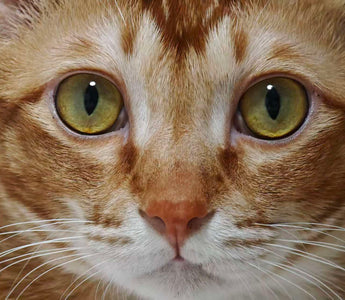
If you've ever wondered why your cat's eyes look the way they do, you're not alone. Why do cats have so many different eye colors? Does eye color tell you anything about breed or health? Which colors are rare? Do a kitten's eyes really change as they grow?
This guide walks through every major cat eye color, explains the genetics behind each one, busts a few myths, and covers when a change in eye color means it's time to call your vet.
What Determines a Cat's Eye Color?
A cat’s eye color comes from melanin, the same pigment that gives color to its skin and fur. The amount and activity of melanocytes in the iris determine whether a cat’s eyes appear green, yellow, copper, or a shade in between.
Here's the simple version:
- Low melanin activity produces green eyes.
- Moderate melanin activity produces yellow, gold, or amber eyes.
- High melanin activity produces orange, copper, or deep brownish eyes.
- No melanin in the iris produces blue eyes. Blue isn't actually a pigment at all. It's the result of light scattering through a colorless iris, the same effect that makes the sky look blue.
Genetics controls all of this. Kittens inherit genes that set how many melanocytes develop in the iris and how active those cells become.
That's why eye color runs in family lines and why certain breeds have signature eye colors written into their breed standards: Russian Blues are bred for vivid green, Bombays for copper, and Siamese cats always have blue eyes.
Age plays a role too. Almost all kittens are born with blue eyes because their melanocytes haven't started producing pigment yet. As melanin production ramps up, the true adult color emerges, usually between 6 weeks and 6 months of age.
Common Cat Eye Colors
Most healthy adult cats have eye colors ranging from green and yellow to copper and brown. Here's a closer look at each shade, how common it is, and which breeds are known for it.
Green Cat Eyes
Green is one of the most striking colors and it's more common than many people assume. A cat with green eyes has relatively low melanin activity in the iris.
Cat eye green isn't a single shade. It covers a wide spectrum:
- Gooseberry green:a pale, almost yellow-green
- True green:a clear, grassy shade
- Emerald green:deep and saturated, often seen in Russian Blues
- Sea green or aqua:green with a hint of blue, common in Tonkinese cats
Breeds famous for green eyes include the Russian Blue, Egyptian Mau, Norwegian Forest Cat, and Havana Brown. Many mixed-breed cats have green or green-gold eyes as well.
Fun fact: because green eyes have low pigment, they shift in apparent shade with lighting. The same cat can look green-eyed in daylight and almost yellow-eyed under warm indoor lights.

Yellow Cat Eyes
- Pale yellow:light and lemony, sometimes with a green rim
- Golden:rich and warm, the classic "cat eye" color
- Amber:a deeper honey tone that leans toward orange
The difference comes down to melanin. Pale yellow eyes have less pigment activity than amber eyes, which sit closer to the copper end of the spectrum.
Breeds known for yellow or golden eyes include the Bengal, Burmese, American Shorthair, Manx, and Sphynx. Black cats of all breeds commonly have yellow or gold eyes, creating the classic Halloween look.

Brown Cat Eyes
Some cat parents may have the doubt: can a cat have brown eyes.
The direct answer: cats do not have true dark brown eyes. A cat with brown eyes always has deep copper or dark amber eyes that look brown in certain lighting.
Human eyes can pack enough melanin into the iris to appear nearly black. However cat eyes max out at copper.

So if you've seen a brown eyed cat, what you actually saw was one of these:
- Deep copper eyes viewed in dim or warm lighting
- Dark amber eyesthat read as brown from a distance
- Hazel eyes, a mix of green and gold that can look brownish
Deep copper eyes on a solid-colored cat are among the most dramatic looks in the cat world. They're just not technically brown.
Orange / Copper Cat Eyes
A cat with orange eyes has one of the most pigment-rich eye colors possible. Orange and copper sit at the high end of the melanin spectrum.
What's the difference between orange and copper?
- Orange eyesare bright and vivid, like a flame or a fresh apricot.
- Copper eyesare darker and richer, with red-brown undertones, like a polished penny.
Genetically, both result from very high melanocyte activity in the iris; the exact shade depends on how densely the pigment is distributed.
Breeds known for orange or copper eyes include the Bombay (whose breed standard calls for copper eyes against a jet-black coat), British Shorthair, Persian, Turkish Van, and the Chartreux, famous for brilliant orange-gold eyes.

Blue Cat Eyes
Blue cat eyes are a special case. Blue isn't a pigment: blue-eyed cats have little or no melanin in the iris, and the color comes from light scattering.
Blue eyes in adult cats show up in three main situations:
-
Colorpoint breeds
Siamese, Balinese, Birman, Ragdoll, Himalayan, and Tonkinese cats carry a gene that limits pigment production, resulting in their pointed coats and blue eyes. All purebred Siamese cats have blue eyes. -
White cats
The dominant white gene can block pigment development, including in the eyes. White cats with blue eyes have a higher risk of congenital deafness because the same gene can affect the inner ear. However, not all blue-eyed white cats are deaf. -
Cats with white spotting
The gene responsible for white patches can sometimes affect eye color, causing one or both eyes to appear blue, even in cats that are not completely white.

Odd-Eyed Cats
Odd-eyed cats have two different colored eyes, usually one blue and one green, yellow, or copper. The technical term is heterochromia iridis.
It happens when the white spotting or dominant white gene blocks melanin from reaching one eye but not the other: the blue eye is the one without pigment.
Odd eyes appear most often in white or mostly white cats, including the Turkish Van, Turkish Angora, Khao Manee, Japanese Bobtail, and white Persians. The feature is purely cosmetic and vision is normal in both eyes. The only caveat is an elevated chance of deafness on the side with the blue eye.

Can Black Cats Have Different Eye Colors?
Yes. Black cat eyes come in the full range of standard colors: yellow, gold, amber, green, and copper.
A black cat with glowing yellow eyes is real and common, but it's not automatic. Coat color genes and eye color genes are inherited separately. Black cats trend toward higher-pigment eye colors, but plenty have green or green-gold eyes.
Blue is the one eye color you rarely see in black cats. Blue eyes usually result from genes that reduce or block pigment, such as the colorpoint gene, dominant white gene, or white spotting gene. Since solid black cats produce high levels of pigment, they typically do not have blue eyes. A “black” cat with blue eyes is often a dark colorpoint mix rather than a true genetically black cat.
Why the yellow-eyed stereotype, then? Partly statistics, since yellow is the most common cat eye color overall, and partly contrast: yellow and copper eyes stand out dramatically against black fur.

Which Cat Eye Colors Are the Rarest?
The rarest cat eye colors are odd eyes (heterochromia), dichroic eyes (two colors in one iris), and true copper. Blue is uncommon in the general cat population but standard in colorpoint breeds. Yellow and green shades are the most common.
Here's how the colors rank:
|
Eye Color |
Common or Rare |
Typical Breeds |
|
Yellow / Gold |
Very common |
American Shorthair, Bengal, Burmese, mixed breeds |
|
Green |
Common |
Russian Blue, Egyptian Mau, Havana Brown |
|
Hazel (green + gold) |
Common |
Abyssinian, Bengal, feral/mixed populations |
|
Amber |
Fairly common |
Norwegian Forest Cat, Somali |
|
Orange |
Less common |
Chartreux, Turkish Van, Persian |
|
Copper |
Uncommon |
Bombay, British Shorthair, Persian |
|
Blue |
Uncommon overall; standard in pointed breeds |
Siamese, Ragdoll, Birman, white cats |
|
Odd eyes (heterochromia) |
Rare |
Turkish Van, Turkish Angora, Khao Manee |
|
Dichroic (two colors in one eye) |
Rarest |
No breed standard; occurs sporadically |
Dichroic eyes deserve a quick explanation since they're the rarest of all. A dichroic eye shows two distinct colors within a single iris, such as a golden ring around a blue center, caused by uneven melanin distribution.

Do Kittens' Eye Colors Change?
Yes. Nearly all kittens are born with blue eyes, and their adult eye color develops over the first several months of life.
Here's the typical timeline:
- Birth to 2 weeks:Eyes open at around 7 to 14 days, and they're blue or blue-gray because the iris contains no active pigment yet.
- 6 to 7 weeks:Melanocytes start producing pigment. Flecks of green, yellow, or gold appear, often starting around the pupil. The eyes may look muddy during the transition.
- 3 to 4 months:The adult color is largely established. A kitten destined for copper eyes will already show warm amber tones.
- 6 months to 1 year:The color deepens and settles into its final adult shade. Copper and orange eyes in particular can keep intensifying into early adulthood.
A kitten that still has blue eyes past 3 to 4 months will likely keep them for life, which usually means it carries colorpoint, dominant white, or white spotting genetics.
Can a Cat's Eye Color Change Later in Life?
An adult cat's eye color should stay stable. A noticeable change is a reason to schedule a veterinary exam.
Normal changes include:
- Kitten-to-adult transition, complete by roughly 6 months to 1 year
- Slight fading with age, as pigment activity slows in senior cats
- Apparent shifts in different lighting, which are optical rather than physical
Changes that may need a vet visit:
- A sudden shift to yellow or green tonesacross the eye, which can indicate jaundice or inflammation
- One eye changing while the other stays the same
- A red, brown, or bloody tint, which can signal bleeding inside the eye
- Cloudiness or a milky blue haze, which may point to cataracts, glaucoma, or corneal disease
- A dark spot that appears or grows on the iris, which can be benign freckling but should be monitored
This guide can't diagnose anything, and most eye changes have manageable causes. The rule of thumb is simple: kitten eye color changes are normal; adult eye color changes deserve a prompt veterinary exam.
Does Eye Color Affect a Cat's Personality?
No. There is no scientific evidence that eye color influences a cat's personality.
This myth persists because eye color is often associated with certain breeds, and breeds can have typical temperament traits. But behavior comes from the breed, not the eye color.
Here's a quick myth-versus-fact rundown:
- Myth:Green-eyed cats are more mischievous. Fact: No study supports any link between iris color and behavior.
- Myth:Yellow-eyed cats are more aloof or "wild." Fact: Yellow is simply the most common eye color, found in cats of every personality type.
- Myth:Blue-eyed cats are less intelligent. Fact: This likely grew from confusion with the blue-eye deafness link in white cats. Deaf cats are just as smart.
- Myth:Odd-eyed cats bring luck. Fact: Charming folklore in Turkish and Japanese traditions, but folklore all the same.
- Fact worth keeping:The one real, documented association is between blue eyes, white coats, and congenital deafness. That's anatomy, not personality.
If you want to predict a cat's temperament, look at its breed, socialization history, and individual experiences.
Cat Breeds and Their Typical Eye Colors
Many pedigree breeds have specific eye colors written into their breed standards. Here are some of the most recognizable pairings:
|
Breed |
Common Eye Colors |
|
Siamese |
Blue (always) |
|
Ragdoll |
Blue (always) |
|
Birman |
Blue (always) |
|
Russian Blue |
Vivid green |
|
Egyptian Mau |
Gooseberry green |
|
Havana Brown |
Green |
|
Bombay |
Copper to gold |
|
British Shorthair |
Copper, gold, orange |
|
Chartreux |
Orange to copper |
|
Persian |
Blue, copper, or odd-eyed (varies by coat color) |
|
Burmese |
Gold to yellow |
|
Bengal |
Gold, green, or hazel |
|
Turkish Van |
Amber, blue, or odd-eyed |
|
Turkish Angora |
Amber, green, blue, or odd-eyed |
|
Sphynx |
Varies widely; often gold or green |
|
Abyssinian |
Gold, green, hazel, or copper |
Mixed-breed cats, the vast majority of pet cats in the United States, can have almost any of these colors.
Amazing Facts About Cat Eye Colors
- Cats' eyes glow in the dark because of the tapetum lucidum.This mirror-like layer behind the retina bounces light back through the eye a second time, boosting night vision and creating the green-gold flash in photos.
- The glow color varies.Blue-eyed cats often reflect red instead because their tapetum is less pigmented. Eye color itself doesn't affect night vision.
- Cats can see in light six times dimmer than what humans need.
- White cats with blue eyes have higher rates of deafness.In odd-eyed white cats, deafness usually occurs on the blue-eyed side.
- The Khao Manee, a rare Thai breed, is nicknamed the "Diamond Eye" catand prized for odd eyes: one blue and one gold.
- Cat eyes never turn truly black.Even the darkest copper eyes stop well short of the near-black brown seen in some dogs and humans.
Owners who watch their cats' eyes tend to be observant owners in general. Daily routines like scooping the litter box, or letting a self-cleaning unit such as the IdealZero B1 handle it, free up a few minutes each day to actually look at your cat: eyes, coat, appetite, behavior. Small changes you catch early are the ones your vet can do the most about.
Frequently Asked Questions
Why are my cat's eyes changing color?
If your cat is under 6 months old, it's the normal kitten-to-adult transition as melanin develops in the iris. In an adult cat, a noticeable eye color change is not normal and can signal inflammation, glaucoma, or other conditions. Schedule a vet visit.
Are green-eyed cats rare?
No. Green is one of the more common cat eye colors, especially in mixed-breed cats. Specific shades, like the vivid emerald of a Russian Blue, are less common because they're tied to particular breeds.
Are orange eyes normal in cats?
Yes, completely normal. Orange and copper eyes reflect high melanin levels in the iris. Breeds like the Chartreux, British Shorthair, and Bombay are specifically bred for these fiery colors.
Can two cats of the same breed have different eye colors?
Yes, in most breeds. Persians, for example, can have blue, copper, or odd eyes depending on coat color and genetics. The exceptions are breeds like the Siamese, Ragdoll, and Birman, where the colorpoint gene guarantees blue eyes.
Conclusion
Cat eye colors come down to two things: genetics and melanin. Kittens' blue eyes will change in the first few months. An adult cat's eyes changing color is not, and it's worth a prompt veterinary visit.
Beyond that, enjoy the view. Whether your cat looks up at you with green, gold, copper, blue, or one of each, you're looking at one of the most remarkable eyes in the animal kingdom.


